Fundamental of Interview is a course that introduces the basic principles and skills needed for effective interviewing. It focuses on communication techniques, question structuring, and building confidence for professional and academic interviews.
Turn solid 3/5 answers into confident 5/5 performances with consultant-led preparation designed for busy UK doctors.
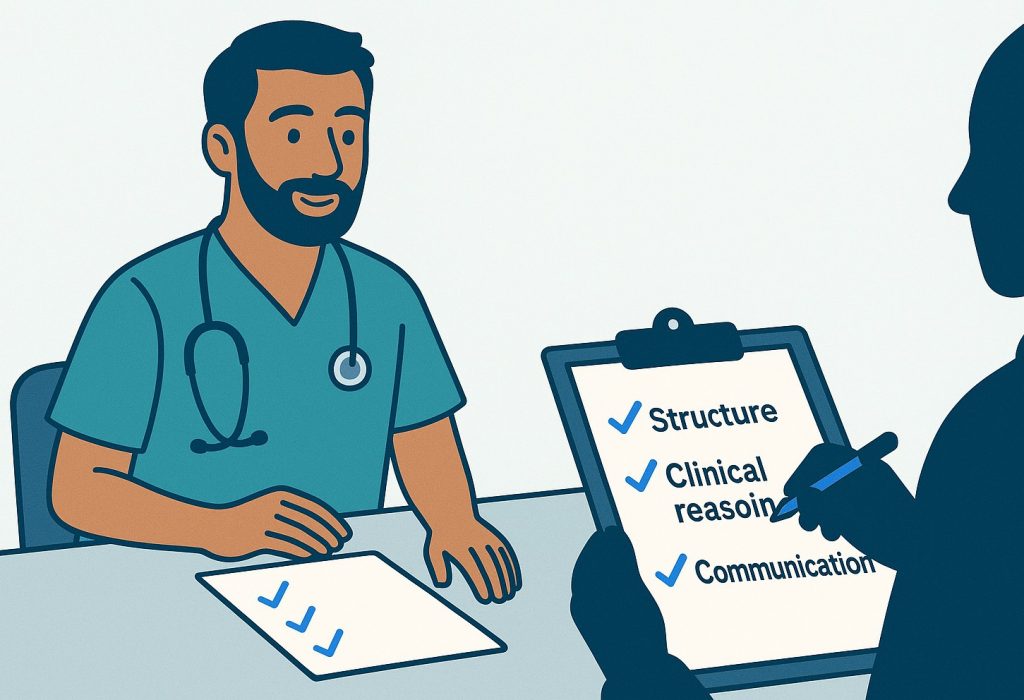
We focus on what interview panels actually mark. Every question is written around real interview stations.
Clear structures for common interview stations, helping you organise high-scoring answers under pressure.
Short, focused podcasts covering
interview strategy and high-yield topics.
Perfect for commutes, gym sessions, or
time between shifts.
Fundamental of Interview is a course that introduces the basic principles and skills needed for effective interviewing. It focuses on communication techniques, question structuring, and building confidence for professional and academic interviews.
Acute Medicine focuses on the rapid assessment, diagnosis, and management of adults with urgent and life-threatening medical conditions. It emphasizes timely decision-making, multidisciplinary teamwork, and continuity of care from admission through early treatment.
Respiratory Medicine is a clinical specialty focused on the diagnosis and management of diseases affecting the lungs and respiratory system. It covers conditions such as asthma, COPD, pneumonia, and respiratory failure, with an emphasis on evidence-based patient care.
Core Surgical Training is a structured postgraduate programme that develops essential surgical knowledge, technical skills, and clinical decision-making. It prepares doctors for higher surgical training through supervised practice, assessments, and professional development.
Preparation for the CST or IMT interview needs to be structured and repetitive.
Most candidates understand the topics — audit, QIP, leadership, ethics, clinical prioritisation — but struggle with clarity, structure and timing under pressure.
Effective preparation involves:
Practising common interview themes repeatedly
Answering aloud, not just reading model answers
Understanding how answers are scored
Refining structure and delivery
Receiving objective feedback
Specialty Ready is built around this principle. Instead of passively watching example answers, you practise speaking, receive structured feedback, and improve through repetition.
Many interview resources provide question banks, recorded model answers or written guides.
Specialty Ready focuses on active performance practice.
You answer questions aloud and receive structured feedback in real time. This allows you to:
Identify gaps in structure
Improve clarity
Refine content
Practise repeatedly without needing a partner
The aim is not to provide scripts, but to help you develop reliable, high-scoring frameworks you can adapt under pressure.
AI feedback is not designed to replace a consultant or panel. It is designed to support structured, high-frequency rehearsal.
We have deliberately calibrated the marking to be slightly demanding. In practice, this means:
Core principles must be present
Safety and prioritisation must be clear
Structure matters
Key elements cannot be omitted
This mirrors how national interview frameworks reward completeness and penalise omissions.
The real advantage is not the score itself — it is the process.
By speaking your answer aloud and comparing it objectively against a structured mark scheme, you:
Identify gaps in reasoning
See where structure breaks down
Recognise missing safety principles
Improve clarity and flow
Build fluency through repetition
Most candidates do not get enough deliberate spoken practice before interview day. AI-supported marking allows you to practise repeatedly without needing a partner, without scheduling constraints, and without the social pressure of “performing” in front of colleagues.
It turns preparation from passive review into active performance training.
Used properly, it becomes a structured rehearsal tool — not just a question bank.
CST interviews typically assess:
Clinical reasoning and prioritisation
Audit and quality improvement
Teaching experience
Leadership and teamwork
Ethical decision-making
Communication under pressure
Portfolio understanding
While the format evolves slightly year to year, the domains remain consistent. Preparation should therefore focus on mastering these core areas rather than memorising scripts.
Specialty Ready provides structured practice questions mapped to these themes.
CST and IMT interviews use structured national scoring frameworks rather than informal impressions.
Each station is marked across defined domains, commonly including:
Content and relevance
Clinical judgement and prioritisation
Insight and reflection
Structure and logical flow
Communication and clarity
Examiners use anchored scoring descriptors. This means marks are awarded based on whether specific criteria are demonstrated, rather than general fluency or confidence alone.
Importantly, interviews also include negative findings.
Omitting key safety principles, failing to prioritise appropriately, demonstrating poor judgement, or missing fundamental ethical considerations can significantly limit your score — even if the rest of the answer is articulate.
In other words, scoring is structured. It is not simply about “sounding good”.
Effective preparation therefore involves:
Understanding common scoring domains
Avoiding critical omissions
Practising structured answers
Demonstrating safe, prioritised reasoning
Specialty Ready is built around this model so you practise in a way that reflects how national interviews are actually marked.
Content is developed by practising doctors with experience of specialty recruitment and interview preparation.
Questions are structured around real interview domains and reflect the expectations of modern recruitment panels.
Future modules are being developed with input from Training Programme Directors to ensure alignment with current selection processes.
Yes — and these candidates often benefit the most.
Interview performance is a skill. It improves with structured repetition.
If you:
Lose structure mid-answer
Speak too broadly
Run out of time
Feel flustered
Then practising aloud in a controlled environment can significantly improve clarity and confidence.
The platform is designed for iterative improvement, not perfection on the first attempt.